
Accurate simulation of Bio-hYbrid Soft Swimmers (ABYSS)
Computational methods for fluid-structure interaction
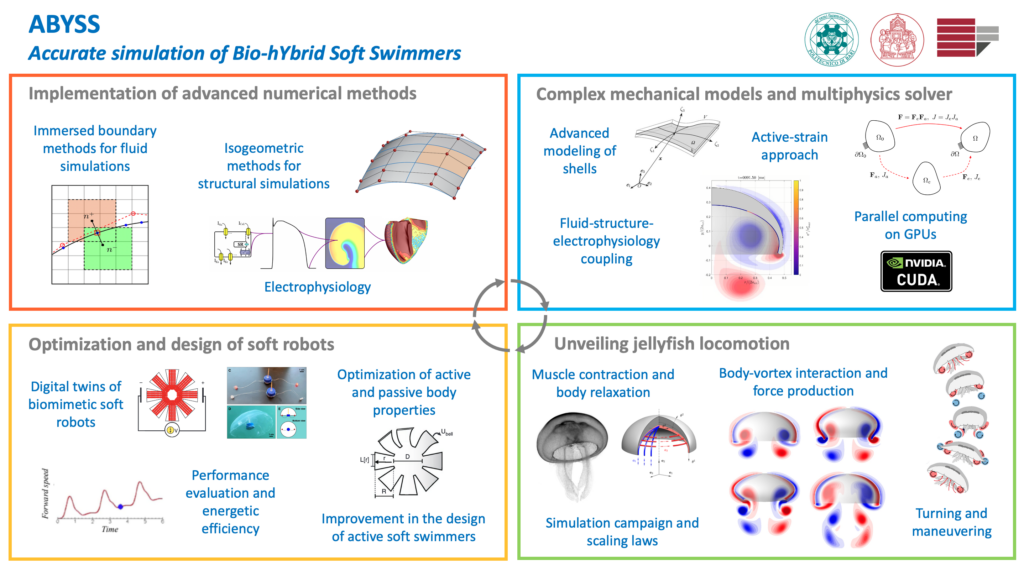
The ABYSS research project is devoted to the numerical simulation of soft bio-hybrid swimmers inspired by jellyfish locomotion. The project is founded on the premise that a holistic digital representation of soft robotic locomotion cannot be achieved by isolating individual physical phenomena. Instead, swimming behavior emerges from the complex interplay among excitation waves propagating through active tissue, the deformation of compliant structures, and the dynamics of the surrounding fluid. Accordingly, the project focused on the progressive integration of these interacting mechanisms within a unified computational framework.
The primary expected outcome of this research was the development of a flexible and accurate computational tool for the study of coupled fluid–structure–electrophysiology interactions, capable of providing high-fidelity predictions of the relationship between actuation and locomotion in pulsatile swimmer models. In particular, by focusing on jellyfish-inspired propulsion, the framework was intended to enable an in-depth understanding of the relationship between activation dynamics and swimming performance. Furthermore, it was designed to support the systematic exploration of design parameters for bio-hybrid medusoids, thereby facilitating the identification of efficient configurations while reducing reliance on extensive experimental campaigns.
The overall objectives of the project were successfully achieved. An efficient computational platform for high-fidelity multiphysics simulations of active soft swimmers was developed through the coupling of advanced methods for fluid–structure–electrophysiology interaction. The framework enabled highly accurate simulations of jellyfish locomotion, allowing the characterization of the entire neuromechanical chain, from electrophysiological activation and muscular contraction to fluid–structure interaction, while clarifying the role of different neuromuscular architectures. The numerical tool was employed to simulate swimming behavior under a variety of conditions while maintaining a level of abstraction sufficient to ensure applicability beyond a single biological organism. A systematic analysis was conducted to assess the influence of the main physiological and control parameters. Detailed investigations of body–vortex interactions provided insight into the mechanisms underlying thrust generation, including the case of asymmetric actuation, characteristic of turning and maneuvering strategies enabling motion control. The simulation campaigns also led to the identification of scaling laws linking electrophysiological actuation parameters to locomotion performance, thereby providing quantitative guidelines for the design and control of artificial systems. Finally, the study was extended to the simulation and design of bio-inspired soft robotic systems, evaluating key performance metrics such as propulsive efficiency and cost of transport. Building upon the knowledge gained from the analysis of natural jellyfish locomotion, the simulations enabled the identification of optimal design solutions in the field of bio-hybrid robotics.
In conclusion, the ABYSS project demonstrated that high-fidelity multiphysics simulations can provide actionable insight and support the rational design of bio-inspired soft swimmers. By combining expertise in fluid dynamics, thin-structure mechanics, electrophysiology, and numerical analysis, the consortium developed a computational framework readily extensible to broader classes of active swimmers and deformable aquatic robots, thereby justifying the continuation of research activities along the directions opened by the project.